

Buy New Comic Book Issues Online: 2026 Collector's Guide
Posted by EDITORIAL TEAM

Table of Contents
- Why Buying New Comic Book Issues Online Beats Waiting for the Rack
- Weekly Comic Book Releases: How to Never Miss New Comic Book Day
- Comic Book Preorders: Lock In Variant Covers Before They Sell Out
-
Setting Up a Comic Book Pull List: A Step-by-Step Walkthrough
- Step 1: Build Your Title Inventory Before You Add Anything
- Step 2: Decide Format Per Title, Not Per List
- Step 3: Set Quantities and Variant Rules Up Front
- Step 4: Choose Your Notification and Delivery Method
- Step 5: Confirm How Holds Interact With Preorders and FOC
- Step 6: Set a Review Cadence and Audit the List
- How the Ron's Comic Closet Pull-Box Service Holds Your Titles
- What a Comic Book Subscription Service Actually Gets You
- Shipping Protection, Bag and Board, and Grading Standards
- Digital vs. Physical Comics: Which Ownership Model Fits Your Shelf
- Conclusion: Build a Buying Routine That Keeps Your Run Complete
- Frequently Asked Questions
Last Updated: October 7, 2026
Why Buying New Comic Book Issues Online Beats Waiting for the Rack
Buying new comic book issues online has become the most reliable way to keep a run complete without gambling on a Wednesday afternoon trip.
The math is simple. When you buy new comic book issues online, you are working from live inventory and preorder windows instead of hoping a physical rack still has stock.

Below, we'll show you exactly how to build a routine that keeps every issue in your run accounted for.
Weekly Comic Book Releases: How to Never Miss New Comic Book Day
New Comic Book Day, or NCBD, is the industry's weekly release window, and it typically falls on Wednesday. Publishers coordinate so most single issues ship on the same day, which makes the weekly comic book releases schedule the single most important calendar you'll track as a collector.

The habit that separates organized collectors from frustrated ones is simple: check the schedule before the week starts, not after.
Reading the Release Schedule and Publisher Dates
Publisher release dates shift. A printing delay or a scheduling change can move a book by a week or more, and the date printed in a preview catalog is not always the date the book ships.
Build a short routine:
- Check the shipping list every Monday for the week ahead
- Note any title in your run that moved
- Confirm your preorders and pull list reflect the change
That four-step check takes about five minutes and prevents the most common collector problem: finding out a book released two weeks ago.
Comic Book Preorders: Lock In Variant Covers Before They Sell Out
Comic book preorders are orders placed before a book ships, and they are the only dependable way to secure a variant cover you actually want. Variant covers are printed in smaller quantities than the main cover, and once a retailer's allocation is claimed, it does not come back.

When to Preorder and Final Order Cutoff Explained
Final Order Cutoff, usually shortened to FOC, is the deadline by which a retailer must submit its order to the distributor.
If a variant matters to you, order it as soon as it appears. Waiting for release week works only for high-print main covers. For anything limited, the preorder window is the whole game.
Setting Up a Comic Book Pull List: A Step-by-Step Walkthrough
A comic book pull list is a standing list of titles a shop sets aside for you each time they release. It is the difference between chasing books and receiving them. Most guides stop at "tell your shop what you read." That advice leaves out the mechanics that decide whether your list actually holds your books, so here is the full walkthrough.
Step 1: Build Your Title Inventory Before You Add Anything
Open your long boxes, your reading app, and your notes app. Write down every ongoing series you are currently following, every mini-series you intend to finish, and every series you are one or two issues behind on. Separate them into three buckets:
- Core titles: books you buy every single month without thinking
- Watch titles: books you like but might drop if the story turns
- Catch-up titles: runs you are filling in from back issues
Only core and watch titles belong on a pull list. Catch-up titles belong in a back-issue order, because a pull list only holds books that have not shipped yet.
Step 2: Decide Format Per Title, Not Per List
A pull list is not all-or-nothing on format. For each title, decide whether you want the single issue, the collected edition later, or both. A common pattern is single issues for series you read monthly and trade paperbacks for series you prefer to read in one sitting. Writing this down per title prevents the most expensive pull-list mistake: buying single issues you will rebuy in a collected edition six months later.
Step 3: Set Quantities and Variant Rules Up Front
For each title, note your default quantity and whether you want variant covers. Variants are where pull lists get complicated, because a shop cannot hold a variant it never ordered. If you always want the main cover, say so. If you want a specific variant, treat it as a separate preorder tied to that book's Final Order Cutoff, not as a standing pull-list line.
Step 4: Choose Your Notification and Delivery Method
Decide how you want to learn that books are ready, email, text, or an account dashboard, and how you want to receive them: in-store pickup, a held box you collect monthly, or shipped. Shipped pull lists usually consolidate into one package per cycle, which matters for both cost and condition. Pickup avoids shipping risk entirely but requires you to actually go.
Step 5: Confirm How Holds Interact With Preorders and FOC
This is the step almost every guide skips. A pull list and a preorder are two different mechanisms:
- A pull list tells the shop to set aside copies from its regular order.
- A preorder tells the shop to order a copy specifically for you before Final Order Cutoff.
If a title is low-print or you want a variant, the pull list alone may not be enough, because the shop's regular order is based on its own demand estimate. Ask your shop how they handle this. The reliable setup is: pull list for standard ongoing titles, preorder for anything limited, variant, or first-issue.
Step 6: Set a Review Cadence and Audit the List
Review your list every three months. Pull the list up, cross out titles you have stopped reading, and add anything new. Then audit the last cycle: did every book you expected actually arrive?
Expected result: Your books are reserved before release day, your variants are locked at FOC, and you stop paying secondary-market prices for issues you could have had at retail.
How the Ron's Comic Closet Pull-Box Service Holds Your Titles
Our subscription and pull-box service holds your titles so they don't sell out from under you. You tell us which series you follow, and we set those books aside as they arrive. There's no monthly commitment required, and you can order individual issues any time without joining anything.
For readers building a long run, that matters. A pull list turns a weekly scramble into a predictable habit.
What a Comic Book Subscription Service Actually Gets You
A comic book subscription service automates the part of collecting that's easiest to get wrong: remembering what you're following and when it ships. The value isn't the discount alone. It's consistency, and the real question is whether that consistency is worth the commitment for how you actually read.
What a Subscription Covers
A subscription typically bundles several functions that you would otherwise manage yourself:
- Automatic holds on your ongoing titles
- Early access to preorder windows for upcoming series
- Consolidated shipping instead of one package per book
The Cost-Benefit Math
Subscriptions are not automatically cheaper. Run the comparison against your own habits:
- If you follow five or more ongoing series: a subscription usually wins, because consolidated shipping and a single invoice replace multiple per-book shipping charges and the time cost of tracking each release.
- If you follow two or three titles casually: ordering individually is simpler and often just as cheap, because you are not paying for consolidation you do not need.
- If you chase variants: a subscription helps only if it includes preorder access. A hold on a standard cover does not secure a limited variant.
The break-even point is not a fixed number. It depends on how many books you buy per month, how many separate shipments you would otherwise pay for, and how much your time is worth. The honest test is to total your last three months of individual orders, including shipping, and compare that to what a subscription cycle would have cost for the same books.
The Commitment Trade-Off
Every subscription carries some form of commitment, and the terms matter more than the pitch:
- Minimum term: some services require a set number of months; others are month-to-month
- Skip and pause rules: can you skip a month without losing your holds?
- Cancellation: how much notice is required, and what happens to books already held?
Read these before you sign up. A subscription that cannot be paused is a poor fit for a reader who travels or takes reading breaks.
Subscription vs. Individual Orders: A Decision Framework
Your Situation |
Better Fit |
|---|---|
Five or more ongoing series |
Subscription |
Two or three casual titles |
Individual orders |
Variant-focused buying |
Subscription with preorder access, or individual preorders |
Irregular reading schedule |
Individual orders or a pausable subscription |
Long-run completionist |
Subscription |
How Ron's Comic Closet Fits
Our subscription service is built around the pull-box model: you tell us which series you follow, and we hold those titles as they arrive. There's no monthly commitment required, and you can order individual issues any time without joining anything. If you want the automation without the lock-in, that is the setup.
Shipping Protection, Bag and Board, and Grading Standards
Shipping protection is what separates a mint condition book from a bent one, and it starts with how a single issue is packed.
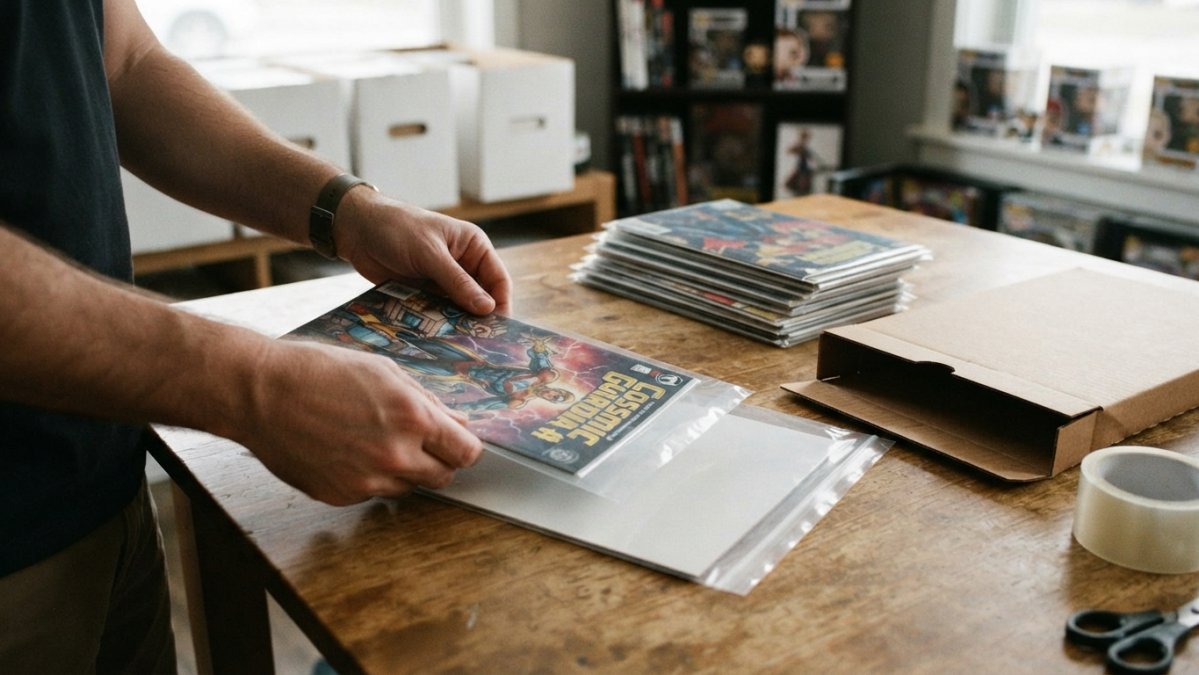
Standards worth knowing:
- Bag and board: a polyethylene or polypropylene sleeve plus an acid-free backing board, the baseline for storage
- Rigid mailer: stiff cardboard that prevents corner damage in transit
- Grading: professional assessment of condition on a 10-point scale, usually through a third-party service
If you're buying key issues or first appearances, ask how the book ships before you buy. A seller who bags and boards every order is telling you something about how they treat inventory.
Digital vs. Physical Comics: Which Ownership Model Fits Your Shelf
Digital comics are licensed access; physical comics are property you own and can resell. That distinction drives most of the decision.
Factor |
Physical Comics |
Digital Comics |
|---|---|---|
Ownership |
You own the copy |
Licensed access |
Resale value |
Yes, market dependent |
No |
Storage |
Requires space and protection |
None |
Condition risk |
Shipping and handling |
None |
Best for |
Collectors, run builders |
Readers, space-limited fans |
Most collectors we talk to end up doing both. They read digitally for convenience and buy physical copies of the issues they want to keep, especially first appearances and key issues.
Conclusion: Build a Buying Routine That Keeps Your Run Complete
The collectors who never miss an issue aren't luckier. They built a routine: check the weekly schedule, preorder what matters, keep a pull list for everything else, and protect what arrives.
Ron's Comic Closet makes that routine easy with a pull-box service that holds your titles, bulk discounts of 10% off three or more items and 15% off five or more, and a catalog that covers new releases, pre-sales, and back issues.
Get started with Ron's Comic Closet and keep every issue in your run accounted for.
Frequently Asked Questions
How much do new comic book issues cost?
Most new single issues land between $4.74 and $5.99 at Ron's Comic Closet. Talespin #1 Cover A is $4.74, Hillbilly: The Treason of Twelve-Toe Maggie #1 is $4.99, Midnight X-Men #1 Cover A is $5.69, and Geiger #25 Cover A is $5.99. Variant covers and anniversary issues can run higher. Buying in bulk helps: Ron's takes 10% off orders of 3 or more items and 15% off 5 or more, which adds up fast if you follow several series at once.
How do comic book subscriptions and pull-box services work?
You tell the shop which series you follow, and a comic book subscription service holds each new issue for you as it releases. A pull list works the same way: your titles get set aside instead of hitting the open rack, so you do not have to race other shoppers on Wednesday. Ron's Comic Closet runs a pull-box service that holds your books until you are ready, and you can order individual issues without committing to a monthly plan if you are still testing the waters.
When should I preorder a new comic book issue?
Preorder as soon as the issue shows up in a shop's pre-sale listings, ideally before final order cutoff. That is the deadline when retailers lock in quantities with publishers, and it is your best shot at variant covers and first-appearance issues that sell out fast. If you wait until release week, you are competing for whatever extra copies the shop ordered. Setting up a pull list covers you automatically for ongoing series.
How can I make sure I don't miss an issue in a series?
Two habits prevent gaps: a pull list and preorders. Add every ongoing title to your pull list so each new issue is held for you on release day, then preorder limited series like Hillbilly: The Treason of Twelve-Toe Maggie, a three-issue run, so you get each chapter without hunting later. Check the weekly comic book releases schedule each week to spot annuals, one-shots, and tie-ins that fall outside your regular pulls.

