

How to Complete Vintage Comic Runs: A Collector's Guide
Posted by RON'S COMIC CLOSET

Table of Contents
- How to Complete Vintage Comic Runs: Start With a Clear Definition
- Step-by-Step Workflow for Completing a Comic Run
- Comic Book Grading Standards: What to Know Before You Buy
- Budgeting and Cost Planning for Vintage Comic Runs
- Best Places to Find Back Issue Comics
- How to Organize Comic Book Collections and Track Progress
- Common Mistakes When Completing Vintage Comic Runs
- Frequently Asked Questions
Last Updated: October 5, 2026
How to Complete Vintage Comic Runs: Start With a Clear Definition
A comic run is every issue of a single title published within a defined span, from one issue number to another, by one creative team or era.
The second problem is scope creep. A Batman run can mean ten issues or four hundred, and the difference decides your budget, your timeline, and whether you ever finish.

Most collectors who stall out do so because they set a boundary in their head and never wrote it down. Write it down first.
"The hunt is half the fun, but only if you know what you're hunting for." -- Common sentiment among long-time collectors
Step-by-Step Workflow for Completing a Comic Run
Completing a comic run follows five repeatable steps: define the boundaries, build an issue checklist, inventory what you own, prioritize the gaps, and source missing issues one at a time. The workflow matters more than any single purchase.
Here is the sequence we recommend:
- Write the run boundary as a start issue and an end issue.
- Build a checklist of every issue number inside that range.
- Mark which issues you already own and their condition.
- Rank the missing issues by importance and price.
- Source them in priority order, verifying condition before you buy.
That last step is where most collections stall. Buying randomly feels productive but leaves you with duplicates and holes.
Build Your Issue Checklist and Set Run Boundaries
An issue checklist is a simple numbered list of every issue in your run, with a column for owned, missing, and condition. Run boundaries are the two issue numbers that bookend it.
Set boundaries using natural break points: a writer's first and last issue, a story arc's conclusion, or a publisher relaunch. A run that ends at issue #400 is easier to complete than one that ends "sometime in the 1990s."
Track Missing Issues and Set Purchase Priorities
Track missing issues in a spreadsheet or a collector app, then sort them into three tiers: must-have keys, mid-tier gaps, and commons. Buy commons in bulk lots, chase keys individually.
Comic Book Grading Standards: What to Know Before You Buy
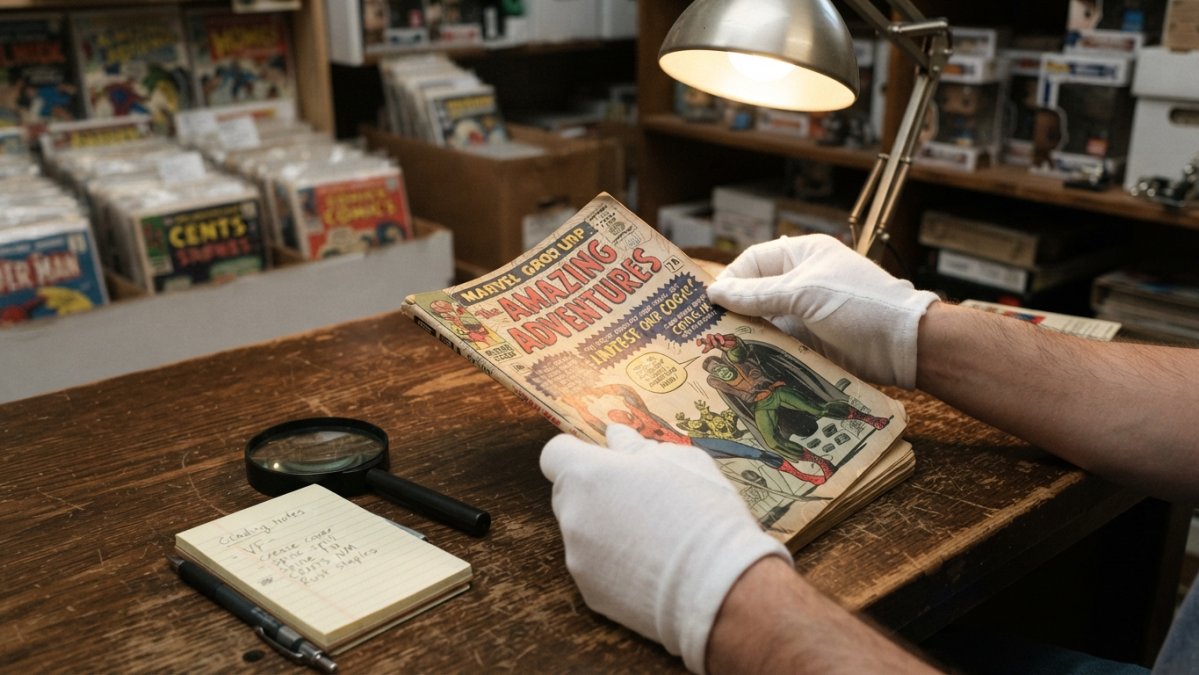
Comic book grading standards describe a book's condition on a 0.5 to 10 scale, and that grade drives most of its value.
What most guides skip is the part that actually protects your money: a fixed inspection order you run the same way every time, so you compare books against each other instead of against your mood.
A Repeatable Pre-Purchase Inspection Sequence
Work from the outside in, and stop the moment a defect crosses your threshold:
- Front cover under raking light. Tilt the book so light skims the surface. Spine ticks, color-breaking creases, and subscription creases show up here and nowhere else.
- Spine and staples. Look for split spines, popped staples, rust migration around the staples, and stress lines at the top and bottom staple. Rust stains bleed through pages over time.
- Corners and edges. Check for chipping, blunting, and the triangular crease at the top-left corner that signals a hard drop.
- Centerfold and page count. Open to the middle. Confirm the centerfold is attached and count pages against a known issue. A missing coupon or ad page is a completeness defect even when the story reads fine.
- Back cover and interior pages. Foxing (brown spotting), tanning at the edges, water stains, and clipped coupons all live here.
- Restoration tells. Trimmed edges look too square; color touch hides as slightly off-tone patches; a cleaned and pressed book can look suspiciously flat. Compare the cover's gloss and paper tone against the interior pages.
What Each Defect Does to Value
- Spine ticks and non-color-breaking creases: minor, often one grade step.
- Color-breaking creases and subscription creases: larger hits, especially on keys.
- Foxing, water damage, and rust: condition problems that compound and are hard to reverse.
Verifying a Seller's Grade Claim
A grade is an opinion until a third party confirms it. Before you buy a high-dollar key:
- Ask for the exact grade and who assigned it. A raw book graded by the seller is a claim, not a certification.
- Request back-cover, centerfold, and staple shots, not just the front.
- Ask directly whether the book is restored, trimmed, or missing any pages or inserts.
Budgeting and Cost Planning for Vintage Comic Runs
Budgeting a comic run means separating the cost of commons from the cost of keys, then funding them from different pools. Commons often cost a few dollars each.
A workable split: put most of your monthly budget toward commons and mid-tier issues, and set aside a separate fund for the two or three keys that anchor the run.
Batman #423 Facsimile Edition Cover C Todd McFarlane Foil Variant →
Track every purchase against your checklist. Spending without tracking is how collectors end up with three copies of issue #12 and no issue #1.
Best Places to Find Back Issue Comics
The best places to find back issue comics are dedicated comic shops with deep back-issue bins, online back-issue retailers, comic conventions, collector forums and auction sites, and direct trades with other collectors.
Match the Channel to the Gap
- Local shops with deep back-issue bins. Best for commons and mid-tier issues. You inspect condition in person, avoid shipping, and can negotiate on quantity. The limit is inventory: a shop may simply not have the issue you need.
- Online back-issue retailers. Best for specific issue numbers and long-tail titles. Wider inventory and searchable listings, but you are trusting photos and grades. Buy from sellers with clear return policies and detailed condition notes.
- Conventions. Best for knocking out a long list of commons in one weekend. Hundreds of sellers in one room, and dealers discount heavily on the last day. Bring your checklist and a want list; the volume is the advantage and the disadvantage.
Tactics That Actually Land the Issue
- Keep a written want list with issue number, title, and the grade you will accept. Hand it to every dealer you meet.
- Set up a pull box or subscription at a shop that special-orders. Consistency matters when you are chasing a run over months, not days.
- Buy commons in lots rather than one at a time. A single lot can close a dozen gaps at once.
- Time your convention buying. Dealers are most flexible late on the final day, when packing up beats carrying inventory home.
A Simple Sourcing Order
Start local for commons, go online for specific numbers, use conventions to clear bulk gaps, and save auctions and forums for the keys that anchor the run. Update your checklist the moment a book arrives so you never buy the same issue twice.
How to Organize Comic Book Collections and Track Progress
Organizing a comic book collection starts with bagging and boarding every issue, storing them vertically in a cool, dry space, and logging them in a tracking system. Organization is what turns a pile into a run.
Use these habits:
- Bag and board each issue to protect condition.
- Store boxes vertically, never stacked flat.
- Keep a digital log with issue number, grade, and purchase date.
- Update the log the moment a book arrives.
A tracked collection shows you exactly what's missing at a glance, which is the whole point of the exercise.
Common Mistakes When Completing Vintage Comic Runs
The most common mistakes are buying without a checklist, overpaying for low-grade keys, ignoring condition until after purchase, and letting duplicates pile up.
Other frequent errors: chasing a run without a budget, buying commons one at a time instead of in lots, and storing books in a humid garage where they degrade.
Pick your run, write the boundaries, build the checklist, and buy in priority order. That is the entire method.
Frequently Asked Questions
What is the best way to track missing issues in a comic run?
Start with a written or digital checklist that lists every issue number in the run, including annuals and specials. Mark each issue as owned, needed, or on order. Many collectors use spreadsheet software or a notebook organized by series and issue number. Update the checklist immediately after every purchase so you never accidentally buy a duplicate. For runs with variant covers, note which cover you already own. A simple checklist prevents wasted spending and keeps your comic runs on track.
How do you determine the condition of a vintage comic book?
Condition is assessed across several factors: spine stress, cover gloss, page color, corner wear, and whether the book has been restored. Comic book grading standards range from Poor to Near Mint, with grades like Fine and Very Fine falling in between. Look for color-breaking creases, water damage, missing pieces, and writing on the cover. For expensive issues, professional grading through a recognized service provides an objective grade and a protective holder. Always ask sellers for detailed photos of corners, spine, and centerfold before buying.
Is it better to buy individual issues or complete sets?
It depends on how many issues you still need and your budget. Complete sets save time but often cost more upfront and may include duplicates or lower-grade books you would not choose individually. Buying individual issues lets you target exactly what is missing and pick the best condition for each book. For large runs where you need most issues, a comic lot or bundled comics purchase can reduce per-issue cost. For runs where you only need a few keys, single issues give you more control.
How do you safely store and preserve vintage comic runs?
Use acid-free boards and Mylar or polyethylene bags for each issue. Store books vertically in a cool, dry place away from direct sunlight, humidity, and heat sources. Avoid stacking heavy boxes on top of each other, which can warp covers. For high-value issues, consider professional encapsulation. Keep a dehumidifier in the storage room if you live in a humid climate. Temperature swings cause paper to expand and contract, so a stable environment matters more than a specific temperature.
What are the most common challenges when collecting vintage back issues?
The hardest part is often finding specific issues in the condition you want at a price you are willing to pay. Some issues were printed in low numbers or are considered key issues, making them scarce and expensive. Run boundaries can be confusing when a series renumbers or restarts. Sellers may grade books differently than you would. Shipping damage is another risk. Building relationships with reliable back issue comics sources and setting saved searches helps you find missing issues faster.
Are 40-year-old comic books worth anything?
Some are, and many are not. Value depends on rarity, condition, and demand for the specific issue. Key issues like first appearances, deaths of major characters, or famous story arcs tend to hold value. Common issues from the same era may sell for a few dollars or less. Comic book grading standards matter enormously: a high-grade copy of a key issue can be worth many times more than a low-grade copy. Check recent sold listings for your specific issue to gauge current market value.
Completing a vintage run takes patience, a written checklist, and steady sourcing. Ron's Comic Closet stocks new releases, pre-sales, and back issues, and our subscription and pull-box service holds your titles so you never miss an issue. Bulk buyers save with 10% off three or more items and 15% off five or more. Get started with Ron's Comic Closet and finish the run you've been chasing.

